eBook coming soon!
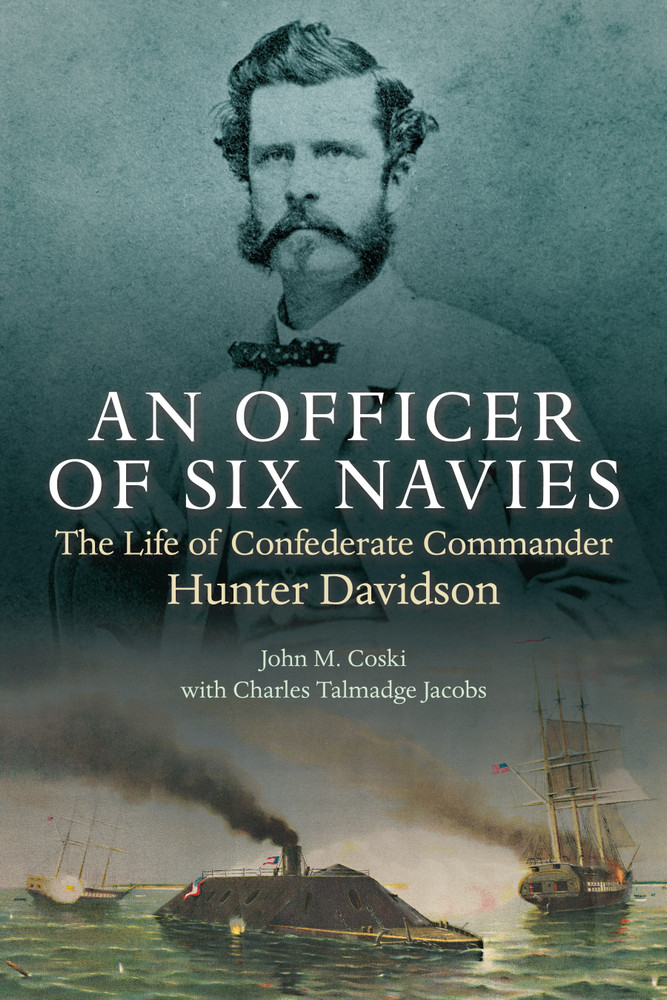
Hunter Davidson (1826-1913) enjoyed one of the most remarkable careers at sea of any officer, and An Officer of Six Navies: The Life of Confederate Commander Hunter Davidson tells his swashbuckling wild story for the first time.
Davidson earned his fifteen minutes of fame in May 1864 when he and his Confederate Submarine Battery Service became the first force to destroy an enemy warship using an electrically detonated torpedo. Davidson also makes the history books as the commander of two gun sections on CSS Virginia in her epic battle against USS Monitor. Before he fought against the U.S. Navy, he served in that navy for nearly two decades, spending time in the Caribbean, the Pacific, the coast of Lower California during the Mexican War, the new Naval School, the Coast Survey, the Africa Squadron, and aboard the exploring vessel HMS Resolute. Considered an intelligent and promising, albeit contentious, young officer, Davidson was an instructor at the U.S. Naval Academy in 1861 when he resigned to join the Virginia State Navy.
After the collapse of the Confederacy in 1865, Davidson struggled to find a new career and support his growing family. The Chilean Navy recruited him and his torpedo expertise to help repel a threatened Spanish invasion. He went on to spend four years as the first commander of the Maryland State Oyster Police before finding a new home in Argentina as commander of that nation’s Torpedo and Hydrographic departments. An “unreconstructed” Confederate, Davidson did not return to his family in Maryland but retired to Paraguay, where he started a second family and endeavored to defend from afar his place in Civil War history.
Davidson’s career typified those of other young U.S. Navy officers of his era who cast their lots with the losing side in the Civil War. In other ways, especially in his 40-year self-exile from the re-united nation, Davidson was virtually unique. His Confederate career alone made him an important and fascinating figure, but his service in or with six different navies gives his life an epic quality.
In 1900, the 73-year-old Davidson described himself as “all broken up with a hard messy uneasy life.” It was a life made harder and messier by his own decisions and his own combative personality. An Officer of Six Navies: The Life of Confederate Commander Hunter Davidson by John M. Coski with Charles Talmadge Jacobs forthrightly explores all facets of Davidson’s “hard messy uneasy” life and introduces readers to one of Civil War history’s forgotten but unforgettable characters.
John M. Coski was for 33 years historian and director of research and publications at The Museum of the Confederacy (subsequently the American Civil War Museum) in Richmond, Virginia. He earned his B.A. from Mary Washington College in Fredericksburg, Virginia, and his M.A. and Ph.D. in American History from the College of William and Mary, working summers for the National Park Service and the Colonial Williamsburg Foundation. He is the author of Capital Navy: The Men, Ships, and Operations of the James River Squadron (Savas Beatie, 1996, 2005) and The Confederate Battle Flag: America’s Most Embattled Emblem (Harvard, 2005), among other publications. He received the Emerging Civil War Award for Service in Civil War Public History.
Charles Talmadge Jacobs was a U.S. Army veteran and career civil servant. He was a founder of the Montgomery County Civil War Round Table and author of Civil War Guide to Montgomery County, Maryland (1983). In 1990, as a retirement project, he began researching the life and career of Hunter Davidson and published an article about him in the Washington Times in 1996. He died of cancer in February 2008, shortly after entrusting his research notes to John Coski.