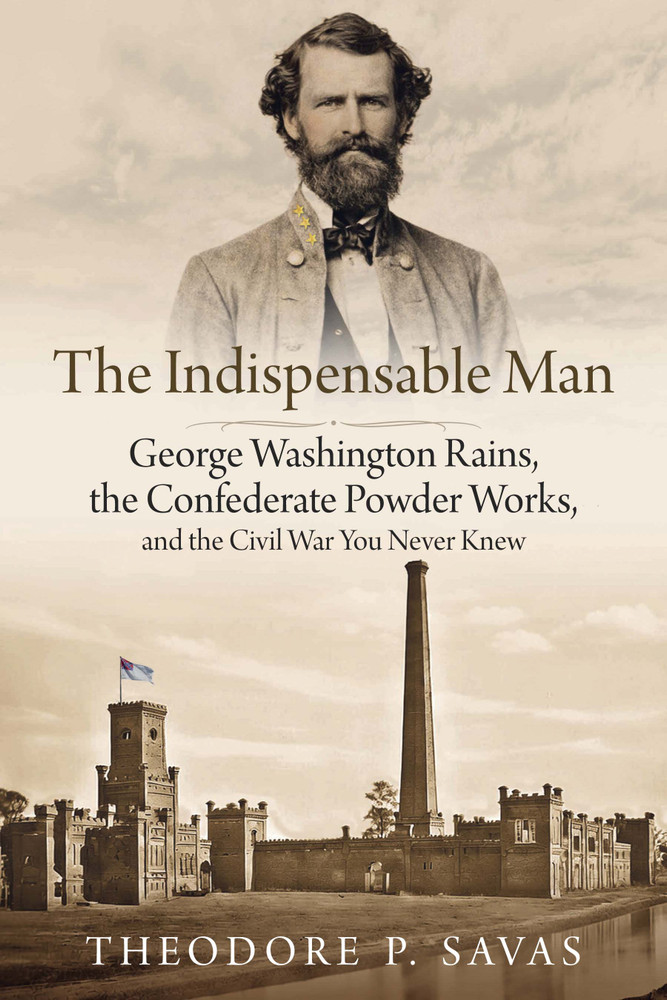
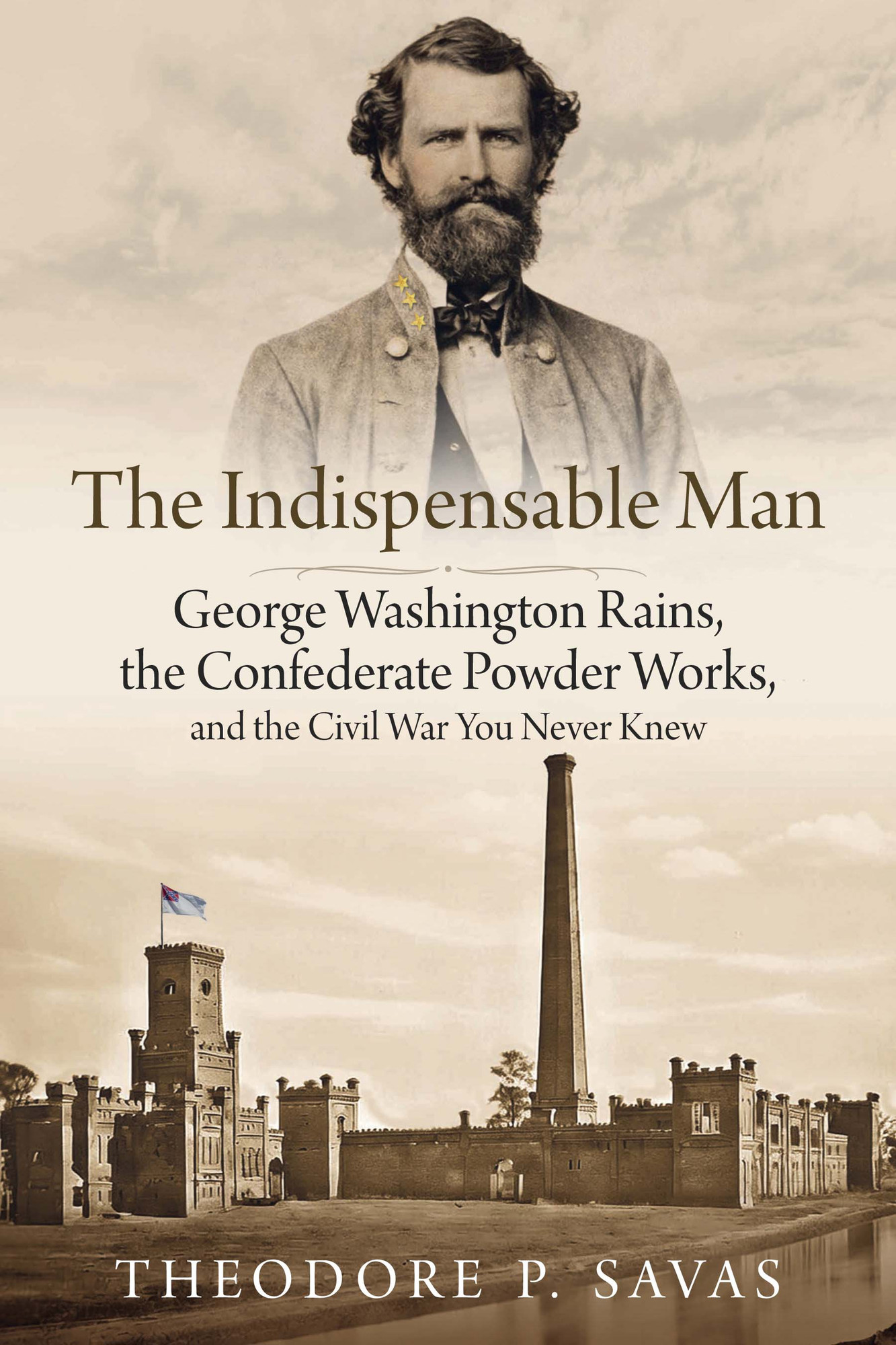
The Indispensable Man: George Washington Rains, the Confederate Powder Works, and the Civil War You Never Knew
- Current Stock:
- Author:
- Theodore P. Savas
- Pub Date:
- November 2026
- ISBN:
- 978-1-61121-
- eISBN:
- 978-1-61121
- Binding:
- Hardcover, sewn, d.j.
- Specs::
- 20 images, 10 maps, 640 pp
- Bookplates:
- Yes
It also provides the best examination to date of the Confederacy's effort to guarantee a
reliable supply of powder during an escalating war. On both counts, it deserves
to find an appreciative audience."
and the author of The Enduring Civil War: Reflections on the Great American Crisis
eBook coming this summer.
Click HERE to read the Introduction!
The Indispensable Man tells the astonishing, little-known story of George W. Rains—a West Point graduate, engineer, combat staff officer, inventor, and entrepreneur whose visionary genius helped shape the course of the Civil War. Rains lived five distinct lives, but it was his fourth, as a Confederate officer working in the shadows alongside generals, politicians, business leaders, and key ordnance personnel, that changed history.
In the summer of 1861, Rains left his wealthy Northern family and traveled to Richmond—not to seek a commission or a field command, but to accept an extraordinary assignment. In a private meeting with President Jefferson Davis—recorded here for the first time—he learned a shocking truth: Confederate gunpowder reserves were “scarcely sufficient for one month of active operations, and not a pound was being made throughout its limit.” Davis tapped Rains to create from scratch a massive powder works “of sufficient magnitude to supply the armies in the field and the artillery of the forts and defences.” The survival of the new nation hinged on his success. Working with remarkable independence and technical mastery, he conceived, built, and managed the Confederate Powder Works in Augusta, Georgia—an industrial achievement unrivaled in the nineteenth century.
Unbeknownst to historians and students alike, Rains’s simultaneous and overlooked efforts in Tennessee during the latter half of 1861 saved Gen. Albert Sidney Johnston’s command. Johnston, explained Rains, “had not sufficient ammunition for an extended skirmish, and there was no remedy until I could manufacture it for him.” While constructing his central mill in Augusta, Rains expanded an old blasting mill, helped erect a second plant, and organized teams across several states to collect and refine niter in Nashville. By late autumn, his network was producing the powder that armed Johnston’s Western army and fortified key positions at Forts Henry and Donelson and elsewhere in Kentucky. These immense but unheralded accomplishments worked in tandem with Davis’s strategy to hold the Union at bay by hiding the South’s fatal weakness until it could fight a prolonged war. Embedded within this story lies a deeper historical question that reshapes our understanding of the war’s first year: To what extent was the Lincoln administration aware of the Confederacy’s crippling vulnerability—and why did it fail to act on that knowledge?
Author Theodore P. Savas spent nearly four decades examining primary sources—many presented here for the first time—to create a deeply researched and vividly written study that offers an entirely new understanding of the war’s first year and challenges long-held assumptions about its crucial opening months. The Indispensable Man: George Washington Rains, the Confederate Powder Works, and the Civil War You Never Knew blends biography, strategy, politics, and narrative suspense to restore one of the conflict’s true unsung heroes to his rightful place. Once you close the final page, you will see the Civil War in a wholly new light—and agree that George Rains was, indeed, an indispensable man.
sable man. Bio: Theodore P. Savas earned a bachelor’s in American history from the University of Northern Iowa and a juris doctorate from the University of Iowa College of Law. He practiced law in Silicon Valley for many years and taught business and history classes as an adjunct at the college level for two decades. He co-founded Savas Woodbury Publishers (later Savas Publishing) in the early 1990s and began Savas Beatie with the late Russel H. Beatie in 2004. Ted is the author, co-author, or editor of many books in a variety of languages, including A Guide to the Battles of the American Revolution, Hunt and Kill: U-505 and the U-Boat War in the Atlantic, Silent Hunters: German U-boat Commanders of World War II (2003), and Brady's Civil War Journal: Photographing the War 1861–65. He has also ghostwritten dozens of titles and published articles in a variety of journals, magazines, and newspapers. His hobbies include scuba diving and playing bass in the hard rock band Arminius in Northern California. He lives in Myrtle Beach, South Carolina.