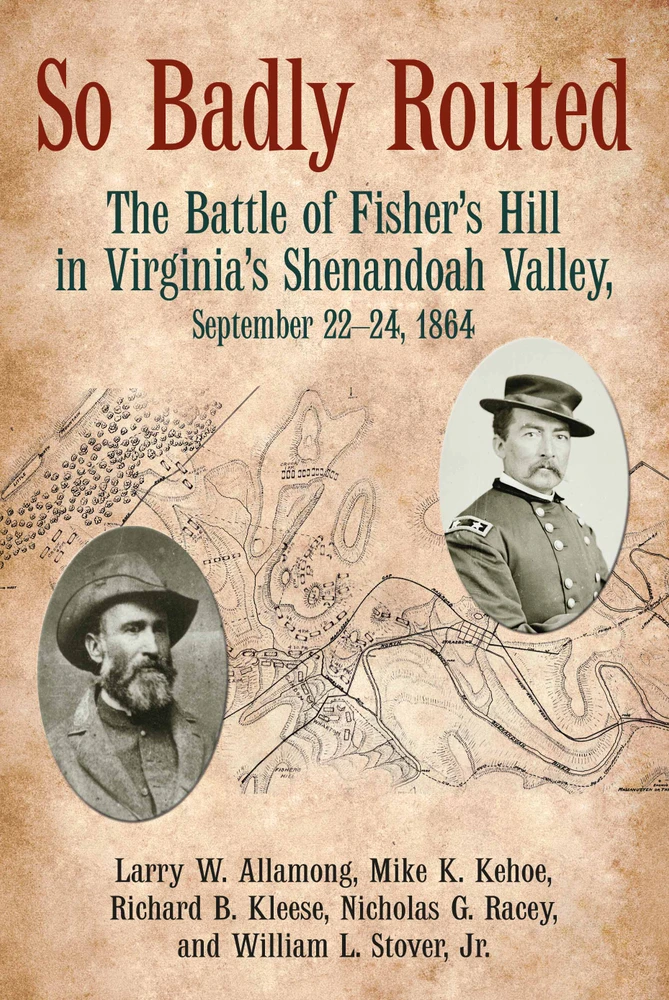


So Badly Routed: The Battle of Fisher’s Hill in Virginia’s Shenandoah Valley, September 22-24, 1864
- Current Stock:
- Authors:
- Allamong/Kehoe/Kleese/Racey/Stover, Jr.
- Pub Date:
- Fall 2026
- ISBN:
- 978-1-61121-793-3
- eISBN:
- 978-1-61121-794-0
- Binding:
- hardcover
- Specs:
- 17 images, 25 maps, 320 pages
- Bookplate:
- Available
Click HERE to purchase the eBook!
Click HERE to read the Front Matter and Chapter 1
“I do not think that there was ever an army so badly routed,” announced Maj. Gen. Phil Sheridan in a message to Lt. Gen. U. S. Grant on the morning after the decisive victory at Fisher’s Hill, Virginia, on September 22, 1864. The battlefield triumph was the result of Sheridan’s elaborate plan to destroy Lt. Gen. Jubal Early’s Confederate Valley army, deployed on a supposedly impregnable position along an aptly named stream called Tumbling Run, south of Strasburg in Virginia’s Shenandoah Valley. This engagement was Early’s last chance to prevent the wholesale destruction of the Valley during the autumn of 1864. So Badly Routed: The Battle of Fisher’s Hill in Virginia’s Shenandoah Valley, September 22–24, 1864, is the first book-length treatment of the battle.
After several unsuccessful Union attempts to control the valley (known as the “Breadbasket of the Confederacy”), Grant directed Sheridan and the Army of the Shenandoah to rid the region of enemy troops and to strip it clean. Grant was tired of Early’s persistent threats to Washington, D.C., and his presence in the Valley helped feed Robert E. Lee’s struggling Army of Northern Virginia.
The authors draw on extensive firsthand archival research to explore the military operations from the days following the Third Battle of Winchester through Sheridan’s attack at Fisher’s Hill. Their descriptions of the fighting—supported by informative maps and firsthand accounts—provide a complete treatment of the decisive battle and related military actions in Warren and Page counties, and of the Mosby Affair at Front Royal. Students and genealogists will welcome the extensive original muster-roll data used to create the Order of Battle, which, for the first time, identifies the actual unit commanders present on the field that day.
In addition to significant new material published here for the first time, So Badly Routed includes pertinent illustrations, complete casualty listings, and a self-guided tour. This study is an important addition to the libraries of Civil War scholars, enthusiasts, and genealogists.
ADVANCE REVIEWS
The 1864 engagement at Fisher’s Hill has long deserved a definitive study, and this is it. No one knows the ground and the sources better than this team of local experts who have produced a book that serves as a model for battlefield monographs. Highly recommended.”
-- A. Wilson Greene, author and battlefield preservationist
“So Badly Routed is the most thorough and authoritative study ever produced on what was long known as the ‘Gibraltar of the Valley.’ Written over the course of a decade by five dedicated historians, it offers an exhaustive yet highly readable account of the campaign, the commanders, and the ground itself. The authors show why Confederate Gen. John B. Gordon could famously summarize the battle in a single word—‘flanked’—while still proving that Fisher’s Hill merits far more than a few words in our historical memory.”
-- Charles Harbaugh IV, Mayor of Middletown, Virginia, and President, Cedar Creek Battlefield Foundation
“As a compete history of the Battle of Fisher’s Hill, this book is first rate, unparalleled in its balance between scholarly detail and clear readability. But what truly sets this volume apart, is what it does to bring the reader face to face with so many of the battle’s individual combatants. Through countless eyewitness accounts and soldier-level battle narratives, the reader is carried back to those fateful days in September 1864 and returns with a greater understanding of the battle and what it was to have fought there.”
-- Keven Walker, Executive Director, Shenandoah Valley Battlefields Foundation
Larry W. Allamong has lived in the community of Fisher’s Hill since 1974 and has farmed and maintained the battlefield land preserved originally by the Association for the Preservation of Civil War Sites. An excellent horseman, Larry has ridden over every inch of the battlefield. Michael (“Mike”) Kehoe was also a resident of Fisher’s Hill. He is the President of the Strasburg Museum, serves on the Board of Directors of the Cedar Creek Battlefield Foundation, and was instrumental in the creation of the Cedar Creek and Belle Grove National Park. He is a principal in M3 Archaeology, LLC and serves as a consultant, field technician, and historian. Mike is a co-author with Joseph W. A. Whitehorne and Clarence R. Gier of A Military of the Events Along Cedar Creek and Fisher’s Hill, The Story of a Battlefield. Richard B. Kleese is self-employed as a CPA in Strasburg, Virginia and is the author of two of the Virginia Regimental Histories published by H. E. Howard, as well as several other Civil War titles. In 1997, Richard was appointed by the United States Secretary of the Interior to serve on the Shenandoah Valley Battlefields National Historic Commission. He has served on the Board of the Cedar Creek Battlefield Foundation and the Board of Directors for the Strasburg Museum. Nicholas (Nick) Racey was born in Cirencester, England and spent his early years as a U.S. Air Force child traveling the world. Nick is a student of the Eastern Theater battles, particularly those involving the 10th Virginia Infantry. He has served as a member of the Board of Directors and as the President of the Strasburg Museum. William L. (Bill) Stover, Jr. is a direct descendant of the original founder of the town of Strasburg, Virginia. His residence at Fisher’s Hill includes portions of the Confederate trench line and artillery position. His professional career includes 44 years with the Virginia Department of Transportation. Bill is a member of the Strasburg Heritage Association, The Shenandoah Historical Society, the Stuart-Mosby Historical Society, the Sons of Confederate Veterans, and serves on the board of Directors of the Strasburg Museum.